
Best Printers For Financial Advisor Firms: Secure, Reliable Office


Running a financial advisor firm? You deal with sensitive data every day. Printing needs to stay fast, accurate, and secure, and you can’t afford to bleed money on the wrong device.
The wrong printer can slow your team, expose data, and waste resources.
The best printers for financial advisor firms are secure, high-speed laser or all-in-one models that handle heavy workloads while protecting client information. You get sharp text, strong access controls, and a low cost per page that fits daily use.
Just like the right office chairs, standing desks, or other home office or or home office setup in general, these printers support contracts, reports, and client packets without delays. Picking the right model helps you stay focused on clients, not tech headaches, especially if you are shopping on Prime Day or via an Etsy store.
Like the perfect office chairs, desk shelf, ergonomic mouse, ultrawide monitor, second screen, monitor arm mount, Wi-Fi connection, USB-C cables, USB mic, USB hubs, USB-A cable, WI-Fi router, OLED screen, desk pad, a smart setup improves workflow, limits downtime, and keeps your office compliant.
Key Takeaways
You need fast, secure printers built for daily financial documents when creating a home office setup.
All-in-one laser printers, including Brother printers, HP OfficeJet Pro 9125e, offer strong value and office efficiency.
Smart printer choices reduce costs and limit issues, and can often be used with a MacBook Pro, MacBook Air, or a PC.
Key Requirements for Printers in Financial Advisor Firms

You deal with sensitive client data, big document sets, and strict regulations. Your printer has to protect information, keep up with demand, and support compliance without slowing down your day.
Document Security Considerations
Financial records often include Social Security numbers, account balances, and tax info. Your printer should support secure printing to keep this data safe.
Look for built-in security features like user authentication, encrypted storage, smart tank, monitor arm, thermal printing, monitor stand, user interface, and other desk caddies, and automatic data wiping. Secure print release is also important in shared offices—it makes sure documents only print when you enter a PIN or swipe a badge.
This cuts down on papers sitting around for anyone to see. Many firms look for financial printers with government-grade security standards. Some models meet strict device security rules, which helps protect client trust.
This lines up with best practices in secure printing for legal and financial firms.
Print Volume and Speed Needs
Your office probably prints reports, statements, and disclosures daily. High-volume printing keeps work moving, especially during tax season or audits.
Slow printers waste everyone’s time and can even disrupt client meetings. Pay attention to print speed, monthly duty cycle, and paper handling.
A reliable financial printer should manage big batches without jamming or losing quality. Cost matters too—check the cost per page for both black-and-white and color.
Lower operating costs help you stay on budget, especially if you share printers with other advisors or accountants. Many offices prefer multifunction financial printers that scan and copy, so you don’t need extra machines cluttering up the place.
Regulatory Compliance Factors
You’ve got to follow financial and privacy rules for document handling. Your printer should support secure storage, access logs, and user controls. These features help you show that you protect data and limit who can see it.
Compliance also means your documents need to look good—clear, accurate prints matter for disclosures and records. Poor output leads to errors and reprints.
Some financial printers integrate with document management systems. This keeps filing and retention consistent. Some choices out there include the Brother laser printer, Canon Pixma TR4720, and HP Office JetPro 9125e.
Services focused on financial printing and document management highlight these needs because regulators expect control, accuracy, and traceability for every printout.
Top Printer Types Suited for Financial Offices

Client records, reports, statements—you print them all the time. Your office printer should deliver speed, clear text, and steady output without drama.
The printer type you choose affects cost control, workflow, and document quality. It’s not a small decision.
Laser Printer Advantages
A laser printer fits most financial advisor firms. It prints fast and handles high volumes. You can run off long reports, contracts, and disclosures without waiting around.
Laser printers deliver sharp black text—important for legal and financial docs. Toner lasts longer than ink, so you don’t have to swap cartridges as often. That keeps monthly costs predictable.
Many firms pick a multifunction printer that scans, copies, and faxes. Less desk clutter, more capability.
Modern office models balance speed and reliability, as seen in top-rated office printers for business use.
Key Strengths:
Fast print speeds for large jobs, and if you are a paper planner.
Lower cost per page over time.
Great for shared office use.
Benefits of Inkjet Printers
An inkjet printer works well for smaller volumes and more flexibility. These cost less upfront and fit small or home-based firms.
If you print client letters, forms, or the occasional color chart, inkjets handle it. They also support photo-quality color, which is handy for branded visuals.
Many compact models offer scanning and copying, so you’re not missing out on basic office tasks. Business model comparisons, like in PCMag’s business printer reviews, and follow the CNET survey, show where inkjets shine.
When Inkjet Makes Sense
Lower monthly print volume.
Limited office space.
Mixed black-and-white and color needs.
Color Laser Printers for Financial Statements
A color laser printer is ideal if you share lots of charts, asset breakdowns, or compliance-ready statements. You get laser speed with consistent color output. That’s useful when clients need to compare reports side by side.
Color laser printers keep color printing costs more stable than inkjets if you print color often. Many banks and advisory firms use them for daily work, as mentioned in guides for financial institutions.
Feature | Color Laser Printer |
Text clarity | Very high |
Color consistency | Stable across pages |
Best use | Statements, charts, reports |
You get a dependable color printer that supports client trust and keeps your records accurate.
Multifunction and All-In-One Printers: Value for Finance Firms

High volumes of client records, forms, and reports are just part of your day. A good multifunction printer (MFP) or all-in-one printer lets you print, scan, copy, and sometimes fax from one device.
These features support accuracy, speed, and secure document handling in a finance office.
Automatic Document Feeder for Streamlined Workflows
An automatic document feeder (ADF) saves you time when scanning or copying big stacks. Just load the pages and let the printer do its thing.
This is a lifesaver for onboarding packets, compliance forms, or signed disclosures. Look for an ADF that supports duplex printing and scanning—it scans both sides in one go, which cuts down on errors and handling time.
Key ADF Features to Check:
Page capacity of at least 35–50 sheets.
Single-pass duplex scanning.
Jam detection with clear alerts.
Many offices rely on AIO models reviewed by PCMag’s all-in-one printer testing because these reviews mimic real office use.
Scanning and Copying Capabilities
Scanning quality is just as important as print quality. You want clean text, straight pages, and accurate file sizes for client records when doing a multi-monitor setup.
An MFP should scan directly to email, network folders, a mesh WI-FI router system, Mini USB, or secure cloud storage in your home office. Copying speed matters too—slow copy times can create backups during busy hours.
Color accuracy is key if you copy charts or performance reports.
Look For:
300 dpi or higher scan resolution for text.
OCR support for searchable PDFs.
Fast first-copy-out time.
Some firms go for business-focused laser models like those ranked by RTINGS for small business printers. These handle volume without frequent slowdowns.
Choosing the Right All-In-One Model
Match the printer to your office size and document load. Small firms often do fine with inkjet AIO devices that balance cost and quality. Larger teams get more out of laser-based MFPs built for higher monthly volume.
Security and reliability really matter in finance. Devices made for regulated environments, like Xerox multifunction printers for financial institutions, focus on access control and audit support.
When you compare models, focus on:
Monthly duty cycle that matches your workload.
Duplex printing is a standard feature.
Cost per page for long-term planning.
For smaller offices, models like the HP OfficeJet Pro line recommended by Wirecutter’s all-in-one printer guide usually cover daily finance tasks without getting too complicated.
Essential Features When Choosing Printers

Financial advisor firms deal with private records every day. You need printers that protect data, handle big jobs, and work smoothly with modern devices.
Workflows matter too. If your printer can't keep up with your pace, it's just a headache.
Security and User Authentication
Client statements and tax forms contain sensitive data. Your printer should protect this information at every step.
Look for security features like user login, PIN codes, or badge access. These controls limit who can print, scan, or copy documents.
Secure print release is a must. The printer holds your job until you confirm it at the device, so pages don't sit around for others to see.
Many business printers support encrypted data transfer and automatic data wipes on the hard drive. That’s real peace of mind.
Guides on choosing copiers for financial firms always stress strong security controls. If your printer matches the standards of your other office systems, you lower your risk.
Paper Handling and Tray Capacity
Financial offices print a ton of documents. You want paper handling that supports daily workloads without constant refills.
Large paper trays save time and cut interruptions, especially during statement runs or compliance reporting. It's one less thing to worry about.
Support for multiple paper size options matters too. You might need letter, legal, and custom sizes for forms or disclosures.
Dual or triple trays let you switch paper types without fiddling with settings. That’s a relief when you’re in a rush with cable management.
Buying guides like this office printer and copier buying guide explain how tray size and media support affect productivity. Strong paper handling keeps your workflow steady.
Connectivity and Mobile Printing
Your team works across desks, offices, and sometimes client sites. Reliable connectivity matters for everyone to print without delays.
Ethernet and secure Wi‑Fi should come standard on any office printer. If not, keep looking.
Mobile printing adds flexibility. Features like AirPrint let you print directly from iPhones and iPads without extra software.
Android support and secure mobile apps give similar access on other devices. If you’re working off‑site, a mobile printer can help too.
Business printer reviews for 2026 highlight mobile and wireless options as core features, as shown in PCMag’s business printer testing. Strong connectivity keeps your office responsive.
Cost Efficiency and Consumables Management
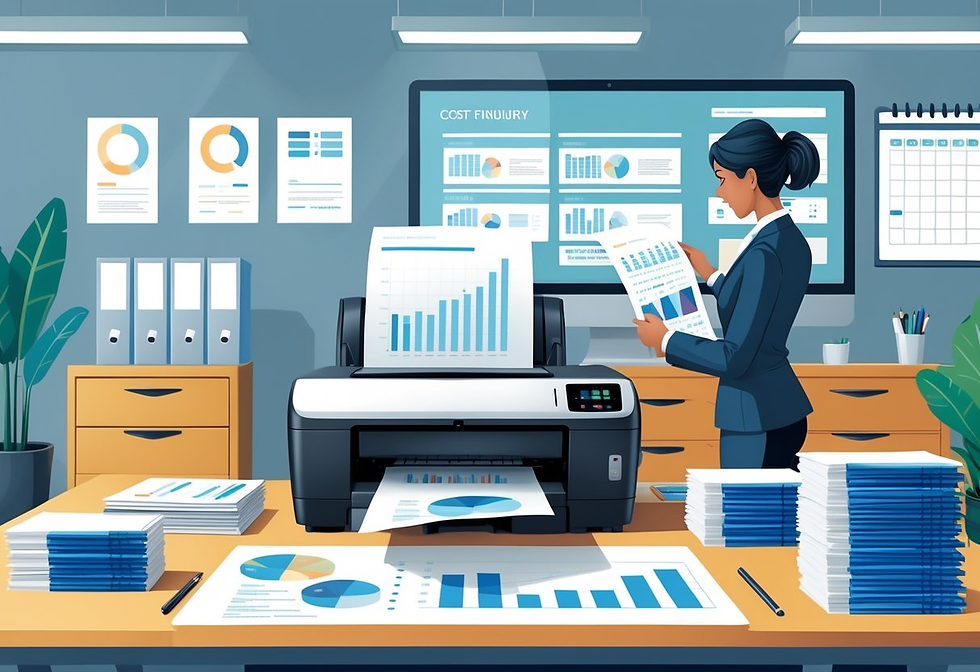
You control long-term print costs by choosing the right consumables and tracking how each page affects your budget. Financial advisor firms print sensitive reports and compliance records, so small cost gaps add up fast.
High-Yield Toner and Ink Solutions
High-yield toner means you replace cartridges less often. This matters when your office prints batches of reports or monthly statements.
High-yield toner cartridges cost more upfront, but they last way longer. You cut downtime and reduce storage needs.
Many business laser printers support high-yield toner by default. They’re a smart pick if you care about volume and reliability.
A closer look at cost-effective printer consumables explains how yield and usage affect operating costs: choosing cost-effective printer consumables.
Calculating Total Cost Per Page
Cost per page is a simple way to compare printers. Just divide the toner or ink by the total number of pages it produces.
This number matters more than the printer’s sticker price. A cheap printer with expensive cartridges can cost more in the long run.
A higher-priced model with efficient toner can save thousands over a few years. Don’t forget to factor in maintenance kits and service plans.
Printing costs can quietly eat into revenue if you don’t track them. A practical breakdown of printer cost drivers appears in this guide on reducing operational costs by choosing the right printer.
Cost Element | Why It Matters |
Toner or ink | Largest recurring expense |
Page yield | Direct impact on cost per page |
Maintenance | Affects uptime and service fees |
Unlimited Ink and Eco-Friendly Options
Unlimited ink plans work for firms with steady print volume. You pay a flat monthly rate and avoid surprise supply costs.
This model helps with budgeting and cuts staff time spent ordering ink. Eco-focused systems like EcoTank printers use refillable ink tanks instead of cartridges.
They cut waste and lower ink cost per page for color-heavy documents. These systems fit offices that print charts or client visuals.
You also reduce environmental impact by using fewer disposable supplies. Many firms balance savings and sustainability by pairing eco-friendly hardware with print rules.
Managed approaches show how this reduces waste while keeping output secure, as outlined in managed print services for financial institutions.
Managed Print Services and Technical Support

For a financial advisor firm, printing has to stay secure, predictable, and easy to manage. Managed print services, solid warranties, and responsive technical support help you cut risk and avoid downtime.
Benefits of Managed Print Solutions
Managed print services take printer headaches off your plate. A provider reviews your devices, usage, and locations, then tailors the setup to fit your firm’s actual workflow.
This often includes consolidating devices, setting print rules, and tracking usage by department or user. Many firms use managed print services to control supply costs and avoid emergency toner runs.
Automatic supply delivery and remote monitoring cut interruptions. Security matters, here too—managed print solutions often add user authentication, audit trails, and secure release printing.
These features help you protect client data and support compliance requirements without adding extra steps to your workflow.
Importance of Warranty and Support
A strong warranty protects you from unexpected repair costs. Even short outages on an OLED screen can delay reports or compliance documents.
Look for coverage that includes parts, labor, ring light, and on-site service. Reliable technical support is just as important as warranty terms.
Providers that specialize in financial firms understand uptime needs and security standards. Some firms pick vendors focused on regulated industries, like those offering managed print services for financial institutions.
You get the most out of support when teams respond quickly and fix issues on the first visit. Clear service-level agreements help set expectations for response times.
Ensuring Reliable Uptime
Printer downtime creates bottlenecks during busy periods. Managed print providers use monitoring software to spot issues before devices fail.
This proactive approach reduces surprise outages and repeat service calls. Many firms rely on providers listed in the top managed print services rankings to ensure consistent coverage.
These providers often support fleets with mixed printer models and multiple locations. To improve uptime, look for:
Remote diagnostics to catch errors early.
Preventive maintenance schedules based on usage.
Loaner or swap programs for critical devices.
These practices keep your printers available when you need them most.
Implementation Tips and Best Practices
Strong printer performance depends on where you place devices, how you protect data, and how well your staff uses the equipment. Financial advisor firms have to balance speed, security, and compliance in daily printing.
Assessing Office Space and Device Placement
Place printers based on workflow, not just convenience. High-volume devices belong near operations staff who print reports and disclosures each day.
Advisors who print less can share smaller devices. Measure available space before installation and check for clearance around paper trays and doors.
Don’t forget maintenance access. Avoid putting printers near client meeting rooms to cut noise and protect sensitive output.
Use This Placement Checklist:
Centralized printers for compliance and operations teams.
Secure locations away from public or client traffic.
Dedicated power and network ports to avoid downtime.
Proper placement reduces delays and lowers the risk of misplaced documents.
Integrating Secure Printing Policies
You need clear rules to protect client data at every print stage. Start with user authentication, like badge or PIN release, so documents print only when the user is present.
This step limits exposure of account statements and personal data. Set default rules that support compliance:
Black-and-white printing for internal documents.
Automatic job deletion after a short hold period.
Encrypted print queues on the network.
Many firms follow guidance from resources like this secure printing guide for legal and financial firms when setting policies.
Review printer logs often to confirm policy use and spot unusual activity.
Training Staff for Optimal Use
You should train staff on both features and rules. Short, role-based training works better than long sessions.
Advisors need quick steps for secure release and mobile printing.
Operations staff need deeper training on batch jobs, error handling, and supply management.
Focus Training on Real Tasks:
Printing client reports without data leaks.
Scanning documents directly to approved systems.
Clearing jams and replacing toner safely.
Post simple instructions near each device. Update training when you change models or security settings.
And honestly, consistency helps everyone. When people use the same steps, things just run smoother, and you won't get as many frantic support calls.
Need more info on this topic? Contact us here.
Next Steps for Your RIA or Broker-Dealer Firm
Secure Wealth IT helps Registered Investment Advisors, broker-dealers, and financial advisors stay secure, compliant, and audit-ready. Explore these free tools and resources:
Free Financial Calculators: calculator.securewealthit.com
Compliance Self-Assessment Tool: regulations.securewealthit.com
Resource Library: Browse free RIA and broker-dealer guides
Watch on YouTube: Secure Wealth IT YouTube channel
Talk to a Specialist: Schedule a free consultation
For more information about this topic, visit us at https://www.securewealthit.com


Comments