
Phishing vs Smishing: What RIA Teams Must Know About Email Threats, Account Takeover, and Wire Fraud


Phishing, Smishing, RIA, email, threats, accounts, takeovers, wire, fraud
A deceptive email phishing scam and a mobile SMS smishing text represent existential cybersecurity threats for every registered investment advisor (RIA). A single email phishing email or mobile smishing attack can trigger credential theft, an M365 account takeover, unauthorized wire transfers, and severe compliance penalties.
Understanding smishing vs phishing threats enables advisory teams to counter social engineering, eliminate wire fraud, safeguard client assets, and satisfy strict regulatory expectations under SEC cybersecurity guidelines.
Phishing arrives by email and smishing arrives by SMS or mobile messaging apps, but both rely on social engineering: convincing an RIA employee to expose credentials, approve MFA push prompts, or authorize fraudulent money movement.
For an RIA firm managing sensitive client wealth across third-party custodial platforms like Charles Schwab, Fidelity, Pershing, Orion, or Tamarac, this distinction shapes defensive controls.
Understanding these delivery vectors helps firms train staff, prevent account takeover, stop unauthorized wire transfers, and document policies for FINRA and SEC regulatory reviews.
Key Takeaways: Phishing and Smishing Threats for the Modern RIA:
Email phishing threats and SMS smishing attacks exploit distinct delivery channels to execute credential theft, M365 account takeover, and unauthorized wire transfers.
Every RIA faces strict SEC regulatory expectations, mandatory incident reporting timelines, and severe compliance penalties if an email phishing or smishing incident compromises client assets or nonpublic personal information (NPI).
Mobile smishing threats bypass traditional email perimeter defenses, using urgent SMS lures to capture one-time passwords and execute MFA fatigue bypass attacks.
Defending an RIA requires layered email security controls, continuous phishing simulations, phishing-resistant MFA, and mandatory out-of-band wire verification procedures to prevent wire fraud.
Failing to prevent account takeover or unauthorized wire transfers exposes RIA leadership to custodial liability, civil litigation, reputation destruction, and enforcement actions from state and federal regulators.
Defining Email Phishing vs. SMS Smishing for RIA Firms
Phishing and smishing are primary social engineering tactics cybercriminals deploy to harvest login credentials, execute financial fraud, or extract sensitive information such as client nonpublic personal information (NPI). The core distinction lies in the delivery channel: email phishing targets desktop inboxes, while smishing strikes mobile devices via SMS text messages.
According to research on credential phishing delivery methods, attackers intentionally exploit the differences between corporate email environments and mobile messaging habits to catch employees off-guard.
In the wealth management sector, both attack methods seek to exploit human trust. Threat actors craft scenarios simulating custodians, software vendors, compliance authorities, or high-net-worth clients to initiate an account takeover and route unauthorized wire transfers.
Phishing vs. Smishing: Direct Comparison for RIA Cybersecurity
Feature / Defense Layer | Email Phishing Threats | SMS Smishing Attacks |
Primary Attack Vector | Corporate email inboxes (Microsoft 365, Google Workspace) | Mobile SMS, iMessage, WhatsApp, and messaging apps |
Inspection Environment | Full email sender headers, inspectable hover URLs, desktop screens | Shortened links, masked caller IDs, truncated mobile screens |
Average Response Window | Hours to days; reviewed during standard office email workflows | Minutes; exploits immediate mobile urgency and instinctive tapping |
Primary Threat Goal | M365 credential theft, Business Email Compromise (BEC), unauthorized wire transfers | MFA bypass, push fatigue manipulation, instant account takeover |
Core Defensive Controls | Secure email gateways, SPF, DKIM, DMARC, inbound email warning banners | Mobile device management (MDM), FIDO2 hardware keys, verbal callbacks |
Regulatory Compliance Impact | SEC Cybersecurity Rule mandates, client NPI loss, severe compliance penalties | FINRA inspection sanctions, compliance penalties, mandatory breach reporting |
What Is Email Phishing?

Email phishing uses spoofed messages to impersonate trusted financial institutions, vendors, custodians, or internal RIA executives. The goal is to trick an RIA employee into clicking malicious links, downloading attachments infected with ransomware or malware, or disclosing credentials on a cloned login portal.
Modern spear phishing attacks against RIA firms are highly customized. Attackers reference authentic custodian forms, recent trade activity, or portfolio management software to deceive advisory personnel.
Once an email phishing lure succeeds, cybercriminals secure the credentials necessary to initiate an account takeover. From there, they quietly stage unauthorized wire transfers and siphon firm capital.
What Is SMS Smishing?
Smishing, also known as SMS phishing, delivers deceptive social engineering lures via SMS text messages, frequently spoofed as urgent fraud alerts, custodian security warnings, courier updates, or emergency multi-factor authentication (MFA) prompts. Mobile users perceive text messages as personal and urgent, leading to rapid engagement.
Because text messages bypass corporate email perimeter firewalls, attackers use smishing to compromise RIA employee smartphones and capture one-time passwords (OTPs).
Smishing attacks also trigger MFA push-bombing campaigns. Attackers flood an RIA advisor's mobile phone with prompts until the user taps approve, allowing instant account takeover.
The Shared Social Engineering Goal: Account Takeover and Wire Fraud
While their delivery vectors differ, both email phishing and SMS smishing serve identical criminal goals: corporate account takeover, sensitive client data theft, and unauthorized wire transfers.
When an attacker compromises an RIA advisor's credentials, they quickly pivot within the advisory firm's ecosystem. They manipulate inbox routing rules, monitor financial conversations, and redirect client disbursements.
The convergence of email phishing and smishing presents compound threats. Failing to counteract these social engineering vectors leaves an RIA exposed to catastrophic wire fraud and regulatory enforcement actions.
How Phishing and Smishing Delivery Channels Threaten RIA Infrastructure

The delivery channel dictates defensive controls, inspection capabilities, and victim reaction times. Email phishing threats allow RIA staff to analyze technical headers and domain signatures before taking action.
In contrast, mobile smishing threats exploit compressed reaction times on handheld screens, heightening the immediate danger of unauthorized wire transfers and account takeover.
Email Phishing Threats Expand the RIA Attack Surface
Corporate email represents the single largest entry point for cyberattacks against advisory firms. High email volumes make it inevitable that sophisticated spear phishing attempts will occasionally evade secure email gateways.
Once a phishing email penetrates an inbox, an attacker can manipulate inbound and outbound correspondence. This access creates an ideal runway for business email compromise (BEC) and unauthorized wire transfers.
Email phishing threats also allow threat actors to study communication patterns between advisors and clients. Cybercriminals mimic writing styles to ensure subsequent wire transfer requests appear genuine.
Mobile Smishing Attacks Exploit Urgency and MFA Fatigue
Smishing attacks compress the decision-making window into seconds. Smartphone interfaces truncate URLs and conceal caller IDs, obscuring warning signs that might otherwise be detected on desktop screens.
Industry data indicates smishing attacks have risen over 300% in recent years as attackers target hybrid and remote RIA employees outside corporate firewall perimeters.
By targeting mobile devices directly, smishing circumvents enterprise email filters. This direct vector makes mobile security a paramount concern for wealth management professionals managing client portfolios on handheld devices.
Multi-Channel Hybrid Social Engineering Threats
Advanced cybercriminals rarely restrict themselves to a single channel. An attacker may initiate contact with a deceptive email, reinforce it with an SMS text alert, and follow up with a vishing or voice phishing call impersonating an IT administrator.
Threat actors increasingly leverage AI voice cloning to mimic authentic custodian support representatives or firm leadership. This cross-channel orchestration builds artificial legitimacy.
The combined pressure convinces RIA personnel to bypass standard verification protocols and approve fraudulent wire requests. Hybrid threats highlight why RIA security policies must address email, text messages, and phone communications simultaneously under comprehensive compliance guidelines.
How Credential Theft, Account Takeover, and Wire Fraud Unfold for an RIA
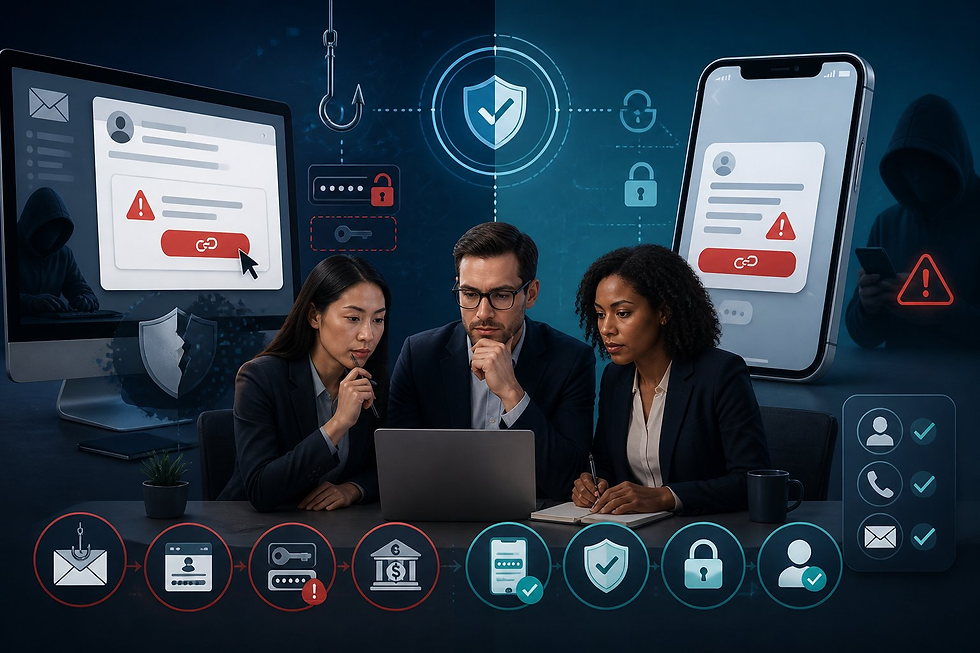
Understanding the attack lifecycle helps RIA leaders identify vulnerabilities before a threat escalates into an unauthorized wire transfer. Criminal groups execute organized playbooks designed to compromise financial accounts and exploit regulatory loopholes.
Phase 1: Reconnaissance and Spear Phishing Formulation
Attackers gather public information about the RIA from corporate websites, LinkedIn, and regulatory filings such as Form ADV. They map organizational hierarchies, identifying key wealth managers, compliance officers, and administrative staff.
Using this intelligence, they forge highly relevant phishing or smishing lures matching the firm's custodians, portfolio management platforms, or billing workflows. Threat actors frequently deploy whaling campaigns specifically targeted at managing directors and founding partners.
This targeted preparation ensures that phishing emails and smishing texts address RIA employees by name, dramatically increasing click-through rates.
Phase 2: Credential Harvest and Multi-Factor Authentication Bypass
The victim is directed to a reverse-proxy adversary-in-the-middle (AiTM) phishing site that mirrors a legitimate Microsoft 365 or custodian login portal. As the user enters their credentials, the site captures the username, password, and real-time session cookie.
Alternatively, smishing actors execute MFA push-bombing attacks, sending repeated approval notifications until an exhausted advisor confirms the login prompt.
By capturing the active session token, the cybercriminal bypasses multi-factor authentication without needing the user's permanent security keys, achieving instant account takeover.
Phase 3: Mailbox Manipulation and Silent Persistence
Following a successful account takeover, attackers rarely trigger immediate alarms. Instead, they configure inbox forwarding rules to hide incoming security alerts and monitor sensitive correspondence regarding capital calls and asset management.
By studying the advisor's tone, scheduling, and client relationships, the attacker identifies ideal opportunities to request unauthorized wire transfers.
This persistence stage can last for weeks or months. The attacker silently collects client financial statements, wire templates, and signature samples, exposing clients to identity theft and unauthorized transactions.
Phase 4: Execution of Unauthorized Wire Transfers and Financial Theft
The attacker inserts modified payment instructions into an ongoing transaction or sends a fraudulent wire request directly to the firm's custodian, impersonating a high-net-worth client.
If the RIA team fails to perform verbal out-of-band verification, the unauthorized wire transfer is executed. Funds are rapidly routed through foreign intermediary accounts, leaving the firm facing severe compliance penalties.
Once money moves across borders or into cryptocurrency tumblers, recovery is nearly impossible. The RIA is left to absorb the loss, face client litigation, and notify regulatory bodies.
Why RIAs Face Higher Stakes: Regulatory
Expectations and Compliance Penalties

An RIA manages substantial client assets and exercises direct authority over financial transactions, making advisory firms prime targets for sophisticated email phishing and smishing threats. A compromised account inflicts immediate operational and reputational damage.
Beyond capital losses, an RIA faces strict SEC and FINRA regulatory expectations regarding data protection, incident disclosure, and cybersecurity governance.
SEC Cybersecurity Guidelines and Mandatory Disclosures
The SEC enforces rigorous cybersecurity expectations under the Investment Advisers Act of 1940, Regulation S-P, and expanded cybersecurity risk management rules. Advisory firms must maintain written policies and procedures reasonably designed to prevent unauthorized access to client records.
Failing to prevent credential theft or delaying reporting of a material cyber incident exposes the RIA to enforcement actions, public censure, and substantial compliance penalties.
Regulators increasingly sanction firms that suffer preventable data breaches stemming from unaddressed vulnerabilities.
Regulators increasingly scrutinize whether an RIA implemented basic cyber hygiene.
Lacking phishing-resistant MFA or documented wire verification protocols directly invites SEC enforcement sanctions.
Custodial Liability and Fiduciary Duty
Registered investment advisors hold a strict fiduciary duty to protect client assets from unauthorized disbursements. Custodians like Schwab, Fidelity, and Pershing often deny reimbursement for wire fraud if the RIA failed to adhere to contractual verification rules.
In addition to client restitution orders, advisory firms risk civil litigation, increased cybersecurity insurance premiums, and catastrophic client attrition following a public compromise.
Common Phishing and Smishing Scams Targeting the
Modern RIA

Cybercriminals focus on recognizable workflows that RIA staff interact with daily. Spotting these precise lures protects firms against unexpected account takeover attempts.
1. Microsoft 365 and Cloud Platform Account Expirations
Deceptive alerts claiming a user's password has expired or that mailbox storage is full remain widespread email phishing lures. These emails contain buttons linking to fake sign-in pages engineered to capture credentials instantly.
Because RIAs rely heavily on cloud-hosted M365 infrastructure, advisors frequently fall victim to these convincingly designed service notifications.
2. Custodian and Portfolio Management Platform Impersonation
Attackers distribute fake notices impersonating platforms such as Charles Schwab, Fidelity, Orion, or Black Diamond. These messages claim an urgent custodial document needs signing or a compliance security update must be applied.
When staff click the embedded link, they land on a cloned portal that harvests credentials, giving criminals access to client portfolio holdings.
3. Fraudulent Wire Instruction and Vendor Invoicing Updates
Compromising a vendor's or client's email allows threat actors to intercept legitimate payment discussions. The attacker supplies updated wiring instructions, routing funds to fraudulent accounts before staff detect the discrepancy.
These invoice redirection schemes account for billions in losses annually and frequently trigger severe compliance penalties when advisory controls fail.
4. Executive Impersonation and Urgent Smishing Transfer Requests
Smishing texts masquerading as an RIA managing partner often claim the executive is stuck in a meeting and urgently requires digital gift cards or an expedited funds transfer. These attacks rely on organizational authority to bypass standard approval channels.
Staff members acting quickly out of deference to company leadership frequently bypass verification safeguards, fulfilling fraudulent transfer demands.
5. Seasonal Tax Scams and IRS Impersonation
During filing deadlines, attackers circulate tax scams disguised as official IRS notices, state revenue advisories, or custodian 1099 updates. These schemes trick advisory teams into transmitting tax filings or client tax identifiers.
Falling for these lures compromises sensitive records and accelerates fraudulent returns or tax-related financial fraud against high-net-worth families.
Phishing and Smishing Red Flags Every RIA Employee Should Recognize

Recognizing the warning signs of social engineering minimizes response latency and stops fraud before money moves. Staff should remain vigilant for the following indicators:
Artificially Induced Urgency: Demands for immediate action, warnings of account suspension, or pressure to execute an unauthorized wire transfer without delay.
Sender Address and Header Discrepancies: Lookalike domains containing subtle misspellings, mismatched display names, or suspicious email headers designed to spoof authentic custodian addresses.
Unsolicited Attachments and QR Codes: PDFs containing hidden redirect links or QR codes (quishing) designed to move communications from protected corporate email gateways to unmonitored mobile browsers.
Requests to Bypass Established Protocols: Any communication instructing an employee to avoid phone callbacks, skip dual-authorization sign-offs, or route requests to personal cell numbers.
Sudden Banking Information Changes: Emails requesting last-minute modifications to wire routing numbers, settlement accounts, or recipient beneficiaries.
Mandatory RIA Wire Verification Checklist to Stop Unauthorized Wire Transfers
To eliminate unauthorized wire transfers and satisfy SEC regulatory expectations, every RIA should enforce this standardized out-of-band verification protocol:
Pause the Transaction: Treat all email or text requests for wire transfers, capital calls, or banking detail alterations as unverified and suspicious by default.
Execute Out-of-Band Callback: Contact the client or vendor using an established, pre-recorded telephone number from your CRM, never using contact information inside the transfer request.
Require Dual Internal Authorization: Require two authorized firm principals to review and sign off on all fund disbursements exceeding established thresholds.
Confirm Account Identifiers Verbally: Verbally verify the recipient bank name, routing number, and account number directly with the client during the live phone callback.
Inspect Mailbox Forwarding Rules: Verify that the advisor's email account has not been modified with automated forwarding rules or hidden deletion filters.
Archive Compliance Documentation: Log the date, time, phone number dialed, voice verification outcome, and authorizing staff member to satisfy future SEC and FINRA audit inquiries.
Essential RIA Security Controls to Prevent Account Takeover and Smishing Threats

Protecting an RIA requires layered defense-in-depth security controls combining advanced technical barriers, centralized management, and verified administrative procedures.
Advanced Email Filtering and Domain Authentication
Deploy secure email gateways configured with behavioral AI to evaluate incoming messages for spoofing indicators. Implement strict SPF, DKIM, and DMARC enforcement policies to prevent cybercriminals from forging your firm's domain.
Automated inbound email banners warning employees of external origin provide an extra visual checkpoint before attachments or links are clicked.
Phishing-Resistant MFA Implementation
Standard SMS two-factor authentication is easily defeated by smishing and SIM-swapping attacks. Transition all RIA team members to phishing-resistant multi-factor authentication, such as FIDO2 hardware tokens (YubiKeys) or certificate-based passkeys, which cryptographically bind logins to verified domains.
Enforcing phishing-resistant MFA halts AiTM reverse-proxy attacks and eliminates credential harvesting vulnerabilities entirely.
Mobile Device Management (MDM) Controls
Enforce MDM policies on all corporate and personal mobile devices accessing RIA email and client portals. MDM enables automatic mobile patching, remote data wiping, and the isolation of corporate data from risky consumer applications.
Restricting access to corporate accounts exclusively to managed, compliant mobile devices prevents unauthorized devices from intercepting firm communications.
Continuous Behavioral Monitoring and Centralized Logging
Monitor M365 and cloud portal logins for impossible travel anomalies, concurrent sessions, and unauthorized inbox rule modifications. Retain tamper-proof audit logs to verify compliance during regulatory reviews.
Automated alerting ensures IT security administrators can isolate compromised user accounts and revoke active sessions within minutes of initial breach detection.
Building an RIA Phishing Simulation and Employee Training Program
Annual security lectures fail to modify real-world employee behaviors. RIA firms must implement practical training programs reflecting modern attack vectors.
Simulate Cross-Channel Attacks: Conduct controlled phishing and smishing simulations mimicking authentic financial scenarios, testing employee responses against fake custodian warnings and wire requests.
Track Actionable Security Metrics: Measure the percentage of employees who report simulated attacks promptly, rather than simply tracking click-through rates. Fast internal reporting is critical to early threat containment.
Establish a Blame-Free Reporting Culture: Encourage advisors to report accidental clicks immediately without fear of reprisal, allowing IT administrators to revoke session tokens before lateral movement occurs.
Documenting continuous security awareness training provides essential evidence during regulatory audits, demonstrating proactive compliance with SEC cybersecurity expectations.
Frequently Asked Questions (FAQ): RIA Phishing, Smishing, and Account Takeover
What is the core difference between email phishing and SMS smishing?
Email phishing relies on fraudulent emails sent to corporate inboxes to steal credentials or deliver malware, whereas smishing utilizes mobile SMS text messages to exploit urgency and bypass email spam filters.
Why are RIAs frequently targeted for account takeover and smishing attacks?
Every RIA manages substantial client wealth, executes high-value financial transactions, and frequently relies on mobile communication. Cybercriminals target advisory firms to orchestrate unauthorized wire transfers and capture valuable client records.
How can advisory firms prevent unauthorized wire transfers caused by email phishing?
Firms must enforce mandatory out-of-band verification callbacks via pre-established phone numbers, require dual-custody authorization for all fund disbursements, and deploy phishing-resistant MFA across cloud inboxes.
What compliance penalties can an RIA face after a phishing breach?
Failing to maintain adequate cybersecurity defenses or experiencing an account takeover can result in substantial SEC and FINRA fines, mandatory client restitution, court-ordered compliance audits, and public disciplinary disclosures.
How does adversary-in-the-middle (AiTM) phishing bypass standard multi-factor authentication?
AiTM phishing sites act as a proxy between the user and the authentic login server. When the victim enters their credentials and OTP code, the proxy captures the authenticated session cookie, enabling instant account takeover without triggering additional security challenges.
Satisfying Regulatory Expectations and Preventing
RIA Compliance Penalties
Email phishing and SMS smishing represent persistent threats to the operational integrity of registered investment advisors. Whether an attack originates from an email lure or a mobile text message, weak security defenses leave the door open to credential theft, account takeover, and unauthorized wire transfers.
Advisory firms cannot afford a passive stance. Failing to meet regulatory expectations exposes your firm to catastrophic financial liability, reputational ruin, and severe SEC compliance penalties.
Strengthen your firm's security posture today. Contact Secure Wealth IT at (704) 769-3663 to schedule a comprehensive compliance readiness assessment, evaluate your phishing and smishing defenses, and align your controls with SEC, FINRA, and NIST cybersecurity standards.
Next Steps for Your RIA or Broker-Dealer Firm
Secure Wealth IT helps Registered Investment Advisors, broker-dealers, and financial advisors stay secure, compliant, and audit-ready. Explore these free tools and resources:
Free Financial Calculators: calculator.securewealthit.com
Compliance Self-Assessment Tool: regulations.securewealthit.com
Resource Library: Browse free RIA and broker-dealer guides.
Watch on YouTube: Secure Wealth IT YouTube channel.
Talk to a Specialist: Schedule a free consultation.
For more information about this topic, visit us at https://www.securewealthit.com


Comments